
Why Some Players Register on Multiple Sites to Play PG Slots
Registering on more than one site is less about “chasing rewards” and more about reducing single-point failure. Online slot play depends on account systems, payment rails, customer support, and server availability—variables that can break even when the game provider is the same. Using multiple sites can be a way to compare conditions and keep sessions predictable, but it also adds complexity that can backfire if you treat it as a shortcut.
One account creates a single point of operational failure
If you rely on only one place to play, any friction in that one account becomes your entire experience: verification delays, withdrawal queues, login issues, policy changes, or maintenance windows. The cause is simple dependency—your session is tied to one set of rules and one set of people resolving problems. The outcome is that small operational issues feel like “the game is broken.” The impact is practical: you lose time, you change behavior mid-session, and you make decisions under uncertainty.
Market comparison is impossible when you have no baseline
Players often judge a site based on a few emotional moments: a fast deposit, a slow withdrawal, one good support chat, one bad chat. The cause is limited sampling—without a reference point, your brain treats one experience as the norm. The outcome is distorted conclusions, such as assuming every slowdown is “normal” or every verification request is “suspicious.” The impact is that you can’t separate common industry processes from unusually poor execution.
Payment rails behave differently across sites even with the same game library
Deposits and withdrawals are not purely technical; they are operational workflows with checks, limits, and timing rules. The cause is that each operator connects to banks, wallets, and fraud controls differently, even if the games offered look identical. The outcome is inconsistent cashflow: one site may process quickly at certain hours while another slows down, or one method may be smooth while another produces repeated errors. The impact is that your session planning—especially stop points—becomes harder if you only have one route.
Redundancy helps when service stability is the real constraint
A slot session can be disrupted by maintenance, server congestion, or regional routing problems that have nothing to do with your phone. The cause is that “uptime” is not a single switch; there are dependencies like authentication services, payment gateways, and content delivery networks. The outcome is partial outages: the lobby loads but the game doesn’t, or deposits work but withdrawals stall. The impact is that having a second option can reduce abrupt session interruptions that encourage reactive decisions.
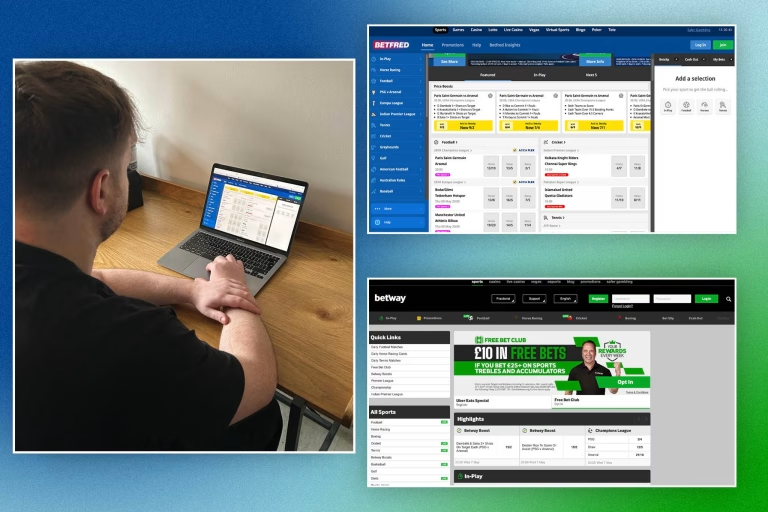
When you notice repeated patterns—certain hours where a betting interface becomes sluggish or customer support goes silent—you can infer that the operator’s capacity is the constraint. In those situations, people sometimes keep an alternative login ready; if they already use ยุฟ่า747, the point is not loyalty or hype, but the ability to switch contexts when reliability drops, so a single operational bottleneck doesn’t dictate the entire session.
How multiple registrations change your risk profile
Registering more accounts does not automatically make you safer; it reshapes risk. The cause is that each account introduces new exposure: more credentials, more KYC, more terms, and more places where a mistake can happen. The outcome can be positive (less dependency) or negative (more administrative burden). The impact is that the “best” setup depends on whether you can manage the extra complexity without cutting corners.
To keep it concrete, here is a sequence that shows the typical logic behind a careful multi-site setup. It’s not a guarantee of anything; it’s a way to reduce avoidable friction by planning the relationship between accounts and behavior.
- Keep one “primary” account for regular sessions and one “backup” for outages or payment disruptions
- Separate testing from real play by using small, controlled trials on the backup first
- Use consistent identity details across accounts to avoid verification mismatches
- Standardize your login security (password manager, 2FA where available) across both
- Track processing times and support response patterns over a few weeks, not one day
- Decide which account is better for your typical hours and payment method, then stick to it
Interpreting this sequence correctly matters more than following it mechanically. The value comes from reducing randomness: small trials prevent you from learning during a stressful moment, consistent identity details reduce KYC friction, and tracking patterns over weeks turns “I feel this site is slow” into an evidence-based conclusion. If you skip the discipline and just accumulate accounts, you increase confusion without gaining stability.
Promotions and bonuses are a poor primary reason, but they reveal hidden constraints
Chasing the highest bonus can push people into low-quality operators or complicated wagering conditions that distort decision-making. The cause is that promotional rules often change the effective cost of play by restricting withdrawals or requiring specific conditions. The outcome is that you optimize for marketing rather than for operational reliability. The impact is that “more value” on paper can translate into more friction in practice.
That said, comparing promotional structures across more than one account can still be useful as a diagnostic tool. It forces you to read terms closely, and it highlights which operators rely heavily on restrictions to manage risk. The lesson is not “collect offers,” but “observe what the rules reveal about how the operator behaves under stress.”
Use a simple comparison table instead of memory
Most people remember the extreme moments: the fastest payout, the worst support chat, the day everything lagged. The cause is recall bias—you don’t remember the normal days. The outcome is that you pick “the best site” based on stories, not patterns. The impact is repeated switching, which adds more uncertainty.
A table keeps the comparison grounded:
| Dimension to compare | What you measure | Why it changes outcomes | What multiple sites reveal |
| Verification friction | Steps, documents, time to approve | Delays block withdrawals | Which operator is consistent vs unpredictable |
| Withdrawal processing | Typical time windows, failure rate | Determines session endpoints | Whether delays are situational or structural |
| Deposit reliability | Error frequency by method | Prevents forced method switching | Which rails are stable for your region |
| Support quality | Response time + resolution rate | Fixes problems before they escalate | Who solves issues vs who stalls |
| Stability at peak hours | Lag, login failures, maintenance | Drives impulsive switching | Which site degrades under load |
Operational consistency, not single-day results, is the key measure of an operator’s reliability. Neither an exceptionally good day nor a particularly bad day is definitive proof of quality or fraud. The true value of the data is its ability to filter out “random noise” and highlight repeated operational patterns. For instance, an operator that consistently struggles with the same phase—such as verification, withdrawals, or stability during peak hours—provides more meaningful information than any large headline bonus. Based on this consistent performance analysis, the site we recommend is คาสิโนออนไลน์ ทรูวอเลท.
Where this strategy fails and creates new problems
Multiple registrations can create a false sense of control. The cause is that switching options can encourage switching behavior: you bounce between accounts whenever you feel unlucky, you lose track of deposits, or you treat admin tasks as “later.” The outcome is fragmented bankroll management and more mistakes—wrong account, wrong method, forgotten limits, repeated verification emails. The impact is that you trade one type of risk (dependency) for another (complexity).
After you’ve broadened your options, the next step is not adding more accounts, but setting boundaries for when you switch and why.
Conditional scenarios where multiple sites become harmful
If you are already struggling to follow a budget, adding accounts increases the number of places you can rationalize “one more try,” which amplifies the behavioral risk. If you frequently reuse weak passwords or share devices, more logins increase the chance of credential loss. If you depend on one payment method that only works smoothly on one operator, extra accounts add administrative noise without practical redundancy.
Summary
Registering on more than one site can be a rational market-comparison and redundancy move because it reduces dependency on a single operator’s verification process, payment rails, support, and uptime. The benefit comes from structure: controlled testing, consistent identity details, and tracking operational patterns over time. The approach fails when it becomes a bonus-chasing habit or a way to switch impulsively, because complexity then increases errors and weakens bankroll control.