
Mobile Proxies Explained: What They Are and How They Work
When I first heard about mobile proxies, they sounded complicated. You are not the only one to have felt the same. Everything makes sense in a very short time once you see how they work.
This guide will take you through the fundamentals, what mobile proxies are, how they work, the different types you will encounter, and how to select a good provider.
Brief Summary
- Mobile proxies use actual 3G/4G/5G mobile networks to direct your traffic.
- They make your activity appear to be a regular smartphone activity.
- Block filters, CAPTCHA and harsh filters on most websites are minimized.
- Ad checks, scraping, and social media management.
- Several varieties of mobile proxies, such as shared, dedicated, rotating, and other forms of mobile networks.
- They are extremely easy to use: your request is redirected to the proxy and the mobile IP is displayed on the site.
- The choice of a good provider implies the emphasis on actual mobile IPs, clean reputation, consistent speeds, and fair pricing.
What Is a Mobile Proxy?
When you use a mobile proxy, it uses a real mobile network IP address, like the one your phone gets from the carrier. Your traffic is sent through a mobile device or a mobile network instead of your home Wi-Fi IP address when you connect to websites.
It looks like you’re doing things from a real smartphone on a 3G, 4G or 5G network.
Websites trust mobile IPs more and treat them as “clean”. This lets people bypass blocks, CAPTCHA and strict filters.
How Mobile Proxies Work (High-Level)
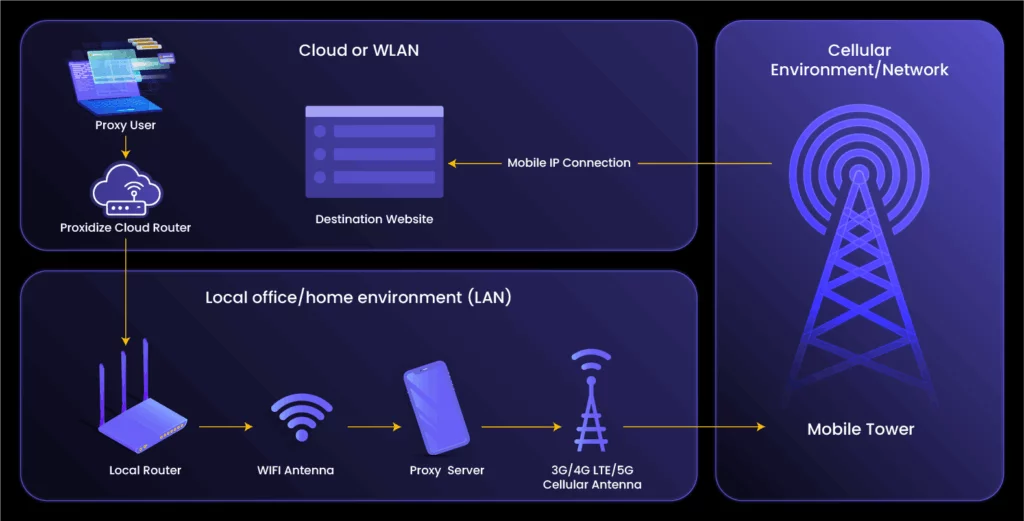
To understand how mobile proxies work, you can see them as a middle layer between you and the website you’re visiting.
Instead of sending requests directly from your device, the proxy sends them through a mobile IP that comes from a real carrier network.
- You send a request (open a website).
- The request is sent to the mobile proxy rather than directly to the site.
- The mobile proxy forwards
- The mobile IP is the only one that is used on the site, not yours.
Types of Mobile Proxies
Before diving in, it’s good to know the different kinds of mobile proxies you can pick from and what each one is meant for.
3G Mobile Proxies
These utilize older 3G connections. They are slower, yet can be utilized for easy jobs that don’t need speed, such as browsing simple pages or performing small-scale automation.
4G/LTE Mobile Proxies
They offer high-speed, consistent connections and clean IPs. It works great for scraping, managing social media, and other ongoing tasks.
5G Mobile Proxies
They are more recent and much faster. Low latency, fast loading and greater reliability. Perfect for high volumes of work or time-sensitive jobs.
Dedicated Mobile Proxies
You receive an IP that is not shared with the other users. Giving you more control and no issues with IP reputation.
Shared Mobile Proxies
It is less expensive, yet the IP can be shared by more than one individual. They are good at easier tasks.
Rotating Mobile Proxies
These automatically change mobile IPs either automatically with time or with a request. Ideal when you need anonymity or massive data gathering.
Core Use Cases (With Mini Playbooks)
People use mobile proxies for all kinds of practical online tasks because websites trust mobile IPs and treat them like real phone users. They can help you avoid frequent login checks and blocks if you control several social media accounts. The idea is to keep your actions calm and steady and switch IPs when it makes sense.
They’re also helpful for scraping – mobile traffic gets fewer captchas. You just keep your request pace reasonable and rotate IPs so you don’t look suspicious. The same applies to ad verification and e-commerce checks.
Advertisers use mobile proxies to see ads the way real users see them, and online sellers use them to check prices or details of products without getting blocked.
Automation tools run smoother with mobile proxies too, since the mobile IP makes your activity look normal. Also, when you need to test how a website loads in a different region, mobile proxies make it easy to view the page like you’re there.
How to Choose a Mobile Proxy Provider
When selecting a good mobile proxy provider, it is all about some simple things that would make the most difference in everyday life:
- Actual mobile networks: Proxy services are to be based on real mobile IPs, not recycled or fake 3G/4G/5G.
- Rotation: You would like to have control of when your IP changes, be it on a timer, be it on request, or just at your will.
- Consistent connection speeds: The best mobile proxies must be able to load pages without slowing or crashing.
- Numerous destinations: The more cities and nations you have, the more possible to test, collect data and social media work.
- Clean IP history: The IPs should be new and not used previously.
- No complex pricing: You should not guess what you are buying and there should not be any limits and surprises.
- Support: In case of an error, fast support is essential.
- Test it: A smaller plan will let you test the proxies before you go any further.