
How Do Reclining Cinema Seats Improve Audience Experience?
A long film asks viewers to hold attention while their bodies remain in one place. In a fixed chair, a person may shift repeatedly to ease pressure at the back or legs, then settle into another imperfect posture. A reclining cinema seat changes that experience by giving the viewer a controlled range of positions. The improvement is less about adding thick padding than about supporting the body and preserving a workable view of the screen as posture changes.
Recline is not automatically comfortable in every auditorium. The seat must fit the row, avoid obstructing a neighbor, and return easily to an entry position. Its headrest, leg support, and controls also need to make sense from the occupied seat. Audience experience depends on the whole sequence: entering, watching, adjusting, using accessories, and leaving.
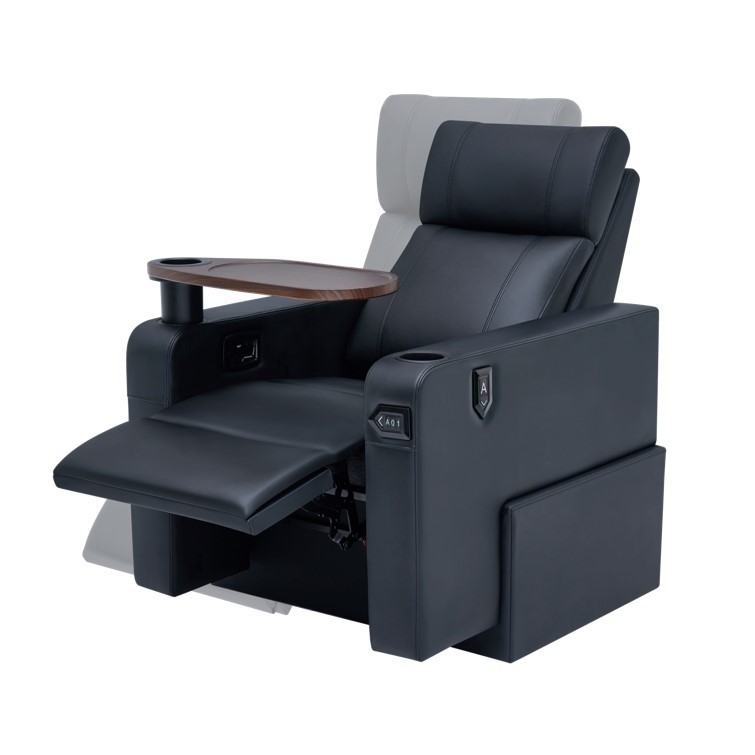
Change Support During a Long Screening
Pressure builds where body weight remains concentrated against a cushion. Changing the back and leg angles can redistribute that contact and give muscles a different position. A reclining cinema seat offers more than a softer surface because it alters the relationship among torso, thighs, and lower legs. The useful range is the range a viewer can actually use without straining or losing the screen.
Leadcom Seating’s Millennium LS-818 Zero Gravity is a powered recliner designed around this change in body position. Its stated reclining geometry aims to distribute weight more evenly and reduce pressure on the neck, back, and legs. The term zero gravity describes the intended posture effect; it is not a clinical guarantee for every body or a substitute for testing comfort with real users.
Adjustment can also give viewers more control over a long program. One person may prefer a modest tilt, while another may extend the leg support further. A fixed setting cannot reflect those differences. Reachable controls let viewers change posture with a brief glance away from the screen. Smooth movement can help reduce disturbances during a screening, while clearly positioned controls make adjustments easier in low light. Visible control markings can reduce fumbling.
Quiet operation matters in a dark auditorium. Motor noise or a sudden mechanical stop can be more noticeable during a quiet scene than in a showroom. The Millennium mechanism is described as smooth and quiet, but a sample row should be tested in the acoustic conditions of the venue. Maintenance access matters too, since a failed powered seat can interrupt an otherwise consistent premium row.
Keep the Screen Comfortable to Watch
Reclining a cinema seat changes the direction of the viewer’s gaze. A position that relaxes the torso may make a person lift the chin to see a screen, especially in a front or steeply stepped row. The screen stays fixed as the viewer reclines; headrest adjustment can compensate for the changed neck angle. The aim is a usable screen sightline without sustained neck effort.
Leadcom Seating offers that headrest as an option for Millennium LS-818. It is meaningful when evaluated against the actual row position and screen height. A viewer in the center of a room and one close to the screen may need different head angles, so the seat’s range should be tested at representative locations rather than judged from a single demonstration seat.
Recline changes the space around a patron. With the back moving toward the row behind, the footrest’s forward travel determines how much passage remains for someone leaving midfilm. The clearance check therefore uses the occupied, extended chair rather than an empty upright row. Where a neighbor cannot pass safely, the available recline range may be limited in practice.
Perceived comfort includes personal space. Privacy panels or couple-seat layouts in other VIP configurations can change how close patrons feel to adjacent viewers. Their effect depends on width, arm arrangement, and local viewing habits. These features should follow the auditorium’s seating concept rather than be assumed to improve every row.
Make Accessories Serve the Visit
Food and personal items often compete with armrest space. An optional swivel food table can keep a snack or small object within reach, but it must move without striking the neighbor or blocking entry. Replaceable arm padding and a flip-up seat cushion address different operating needs: wear and cleaning. Their contribution to the audience experience is indirect but visible over many screenings.
Row lettering and seat numbering help patrons reach their places before the film begins. In a darkened auditorium, legibility and position matter as much as the presence of a label. Leadcom Seating lists these options for the Millennium configuration. They work best when the wayfinding plan and seating layout are designed together.
Premium and standard rows may use different seats, but a recliner’s benefits are experienced one viewer at a time. The relevant questions are whether the person can adjust posture, keep a comfortable view, use the offered accessories, and leave without interrupting others. A sample screening across several seats can reveal those answers more clearly than a feature list alone.
The result is a viewing position that can change with the film’s duration and the viewer’s needs. Across a full screening, adjustable support can ease pressure while the screen stays in view and neighboring patrons retain passage.