AI Patient Simulators vs. Standardized Patients
The global healthcare simulation market is projected to exceed $6.5 billion by 2027, growing at a compound annual rate of over 15%. This growth is not accidental — it reflects a structural problem that medical schools, nursing programs, and clinical training departments have struggled with for decades. Realistic, repeatable, and scalable patient interaction practice remains one of the most difficult and expensive components of healthcare education to deliver consistently.
Standardized patients (SPs) — trained actors who simulate medical conditions for teaching purposes — have long been the gold standard for clinical communication training. They are effective, but they are also costly, logistically complex, and inherently limited in availability. Here’s when AI-powered simulation can enter the game. Companies exploring the best avatars for healthcare training are discovering that AI patient simulators — conversational, photorealistic digital figures powered by large language models — can replicate and, in several measurable dimensions, surpass what standardized patients offer. That’s why the comparison between these two approaches has become one of the most debated topics in medical education today.
What Is an AI Patient Simulator?
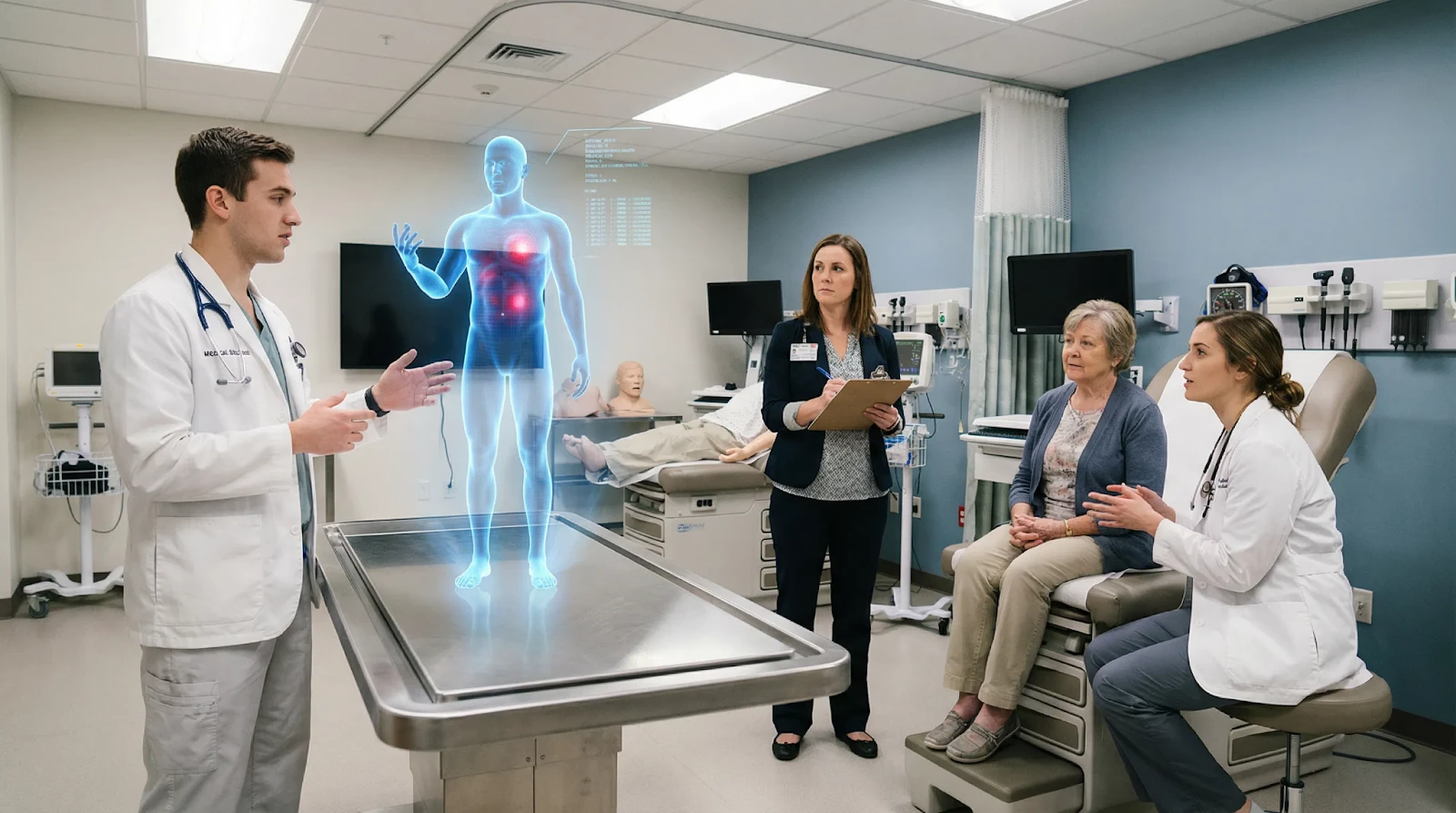
An AI patient simulator is a digitally rendered human avatar capable of conducting realistic clinical conversations with medical trainees. The avatar is built on a combination of natural language processing (NLP), voice synthesis, and photorealistic 3D modeling. It can portray specific medical conditions, emotional states, cultural backgrounds, and communication challenges — consistently and on demand.
In other words, a trainee can practice taking a patient history, delivering a difficult diagnosis, or managing an emotionally distressed patient — without scheduling a human actor, booking a simulation lab, or waiting for a supervisor to be available. The system responds dynamically, adapts to the trainee’s inputs, and can be configured to escalate or de-escalate symptom presentation based on the interaction’s progression.
Given this capability, AI patient simulators are no longer experimental tools. The majority of leading medical simulation vendors are actively developing or already deploying avatar-based systems across undergraduate and postgraduate medical curricula.
Standardized Patients: Strengths and Limitations
Standardized patients have earned their place in medical education. A well-trained SP can deliver nuanced emotional responses, adjust non-verbal cues, and provide immediate feedback that feels genuinely human. These qualities make SPs particularly valuable for high-stakes assessments such as Objective Structured Clinical Examinations (OSCEs).
However, the model carries significant structural limitations.
Key constraints of the standardized patient model include:
- Cost per session — hiring, training, and scheduling SPs involves ongoing expenditure that scales poorly across large cohorts.
- Availability — SPs cannot be accessed outside scheduled sessions, limiting practice opportunities for students.
- Consistency — human actors, regardless of training quality, may deliver varying performances across sessions or student groups.
- Emotional fatigue — repeated portrayal of distressing medical scenarios can negatively affect SP wellbeing over time.
- Scalability — deploying SPs across multiple campuses or remote learning environments is logistically complex and expensive.
When Does It Make Sense to Use AI Patient Simulators?
You should attentively analyze whether AI simulation fits the specific learning objectives before replacing or supplementing SP programs. Not every training scenario is equally suited to digital delivery.
AI patient simulators are particularly well-matched for:
- High-volume repetitive practice — formative skills training that requires multiple repetitions before assessment.
- Communication skills development — history-taking, breaking bad news, motivational interviewing, and culturally sensitive consultations.
- Rare or complex case exposure — presenting conditions that SPs cannot physically simulate, such as specific neurological presentations or complex psychiatric histories.
- Remote and asynchronous learning — enabling students to practice outside institutional hours and from any location.
- Objective performance tracking — capturing detailed interaction data for review by faculty and students alike.
Apart from this, AI simulators are well-suited for early-stage clinical training, where the primary goal is building foundational communication habits before students interact with real patients or high-cost SP assessments.
Key Features of a Reliable AI Patient Simulator
What is also important here is that not all AI simulation platforms are built to the same standard. When evaluating options, institutions should look for the following capabilities.
Conversational Depth and Realism
The avatar should be capable of maintaining a coherent, medically accurate patient persona throughout an extended interaction. This functionality is designed to go beyond scripted responses — the system needs to handle unexpected student inputs naturally, without breaking character or producing clinically inaccurate outputs.
Emotional and Behavioral Variation
A reliable simulator will enable the portrayal of emotional states including anxiety, denial, confusion, and distress. Pay attention to whether the avatar’s vocal tone, pacing, and facial expression adapt dynamically to the conversation’s emotional register.
Detailed Performance Analytics
The system should generate structured feedback reports covering including, but not limited to: question sequencing, empathic language use, clinical accuracy of history-taking, and missed diagnostic cues. These mechanics boost the learning value of each session and allow faculty to identify patterns across student cohorts.
Scenario Library and Customization
The most highly demanded options are platforms that offer both a pre-built case library and the ability to create institution-specific scenarios aligned with local curriculum requirements.
Security and Compliance
Solutions are built based on enterprise-grade data security standards. You should look for HIPAA-compliant platforms with clear data governance policies, particularly when student performance data is captured and stored.
How to Integrate AI Patient Simulators Into an Existing Curriculum
Deploying AI simulation successfully requires a structured implementation approach. The following steps can guide institutions through the process.
- Map training objectives to simulation use cases. Identify which learning outcomes are currently underserved by existing SP programs or require more frequent practice than current resources allow.
- Pilot with a defined student cohort. We recommend beginning with a single year group or module to gather meaningful usage and performance data before scaling.
- Align faculty on assessment criteria. It will be helpful to establish shared rubrics for evaluating AI-assisted practice sessions so that feedback is consistent with existing OSCE standards.
- Integrate analytics into existing reporting workflows. Typical integrations include connections to learning management systems such as Moodle, Canvas, or institutional LMS platforms.
- Establish a review cycle. AI simulators should be audited periodically for clinical accuracy, scenario relevance, and alignment with updated curriculum standards.
- Maintain SP programs for high-stakes assessment. AI simulation is most effective as a formative training tool. Standardized patients may remain the preferred format for summative evaluation contexts where nuanced human judgment is essential.
Conclusion
The question is not whether AI patient simulators will become part of medical education — it is how quickly institutions will integrate them strategically. Standardized patients deliver irreplaceable value in specific assessment contexts, but the operational constraints of the SP model make it an insufficient solution for the volume and consistency of practice that modern clinical training demands.
AI patient simulators offer scalability, accessibility, and objective performance data that traditional simulation methods cannot match at equivalent cost. Thanks to this, institutions that combine both approaches — using AI for high-volume formative practice and SPs for summative assessment — are positioned to deliver significantly stronger clinical communication outcomes across their student populations.