
How to Select an RSV Testing Kit for Clinical and Public Health Laboratories
RSV must appear in an assay’s target list before speed, batch size or the number of other respiratory targets becomes relevant. Similar clinical presentations can lead laboratories to compare several molecular products, although their analytical coverage differs. A PCR test for flu may fit a neighbouring testing task without addressing RSV. An influenza-negative finding leaves an RSV question unanswered when the assay has measured only influenza A and B.
Verify the Organism Behind the Panel Name
The respiratory category identifies a clinical area, not a complete pathogen list. A panel may differentiate two influenza types, or it may include several other viruses alongside them. Assessment of an RSV testing kit has to establish that RSV is among the organisms actually measured, before the remaining features are compared with the laboratory’s intended workload.
An influenza A/B assay illustrates the distinction. A PCR test for flu can distinguish the two influenza targets while leaving RSV outside its scope. That product may be relevant when laboratories compare influenza-only testing with broader respiratory testing, but evidence of RSV detection has to belong to a different assay that explicitly includes it.
Target genes provide a further level of detail beneath the organism names. Several gene regions can belong to one pathogen, while another pathogen may be represented by a single region. Counting those regions is therefore different from counting the organisms reported by a panel. The assay’s target design and interpretation determine which pathogen-specific findings it produces.
The analyte distinguishes molecular RSV testing from antigen testing: an RNA PCR assay detects viral genetic material through target-specific amplification reactions; an antigen assay measures viral protein. Sensitivity values attached to one analytical approach cannot be transferred to the other merely because both bear the RSV name.
A method comparison needs the sample context and evidence appropriate to each approach. Keeping the measured substance explicit also clarifies the extraction requirement: an RNA-based procedure needs a supported nucleic acid preparation before the analytical reaction.
Follow the Proposed Specimen into the Assay
A respiratory specimen still needs a specific description. The collection site and material matter because different preparations can have different composition and handling requirements. Nasopharyngeal swabs, oropharyngeal swabs and sputum cannot be treated as an interchangeable category merely because each may enter respiratory testing. The selected method needs evidence for the material actually submitted.
An influenza-only comparator is the Influenza A and B Viruses Real-Time PCR Kit from BioPerfectus, which qualitatively detects influenza A RNA and influenza B RNA. Its specimens include throat swabs, nasal and pharyngeal secretions, and cell culture supernatant. Those specimen permissions apply to influenza detection, with RSV outside that assay’s defined detection scope.
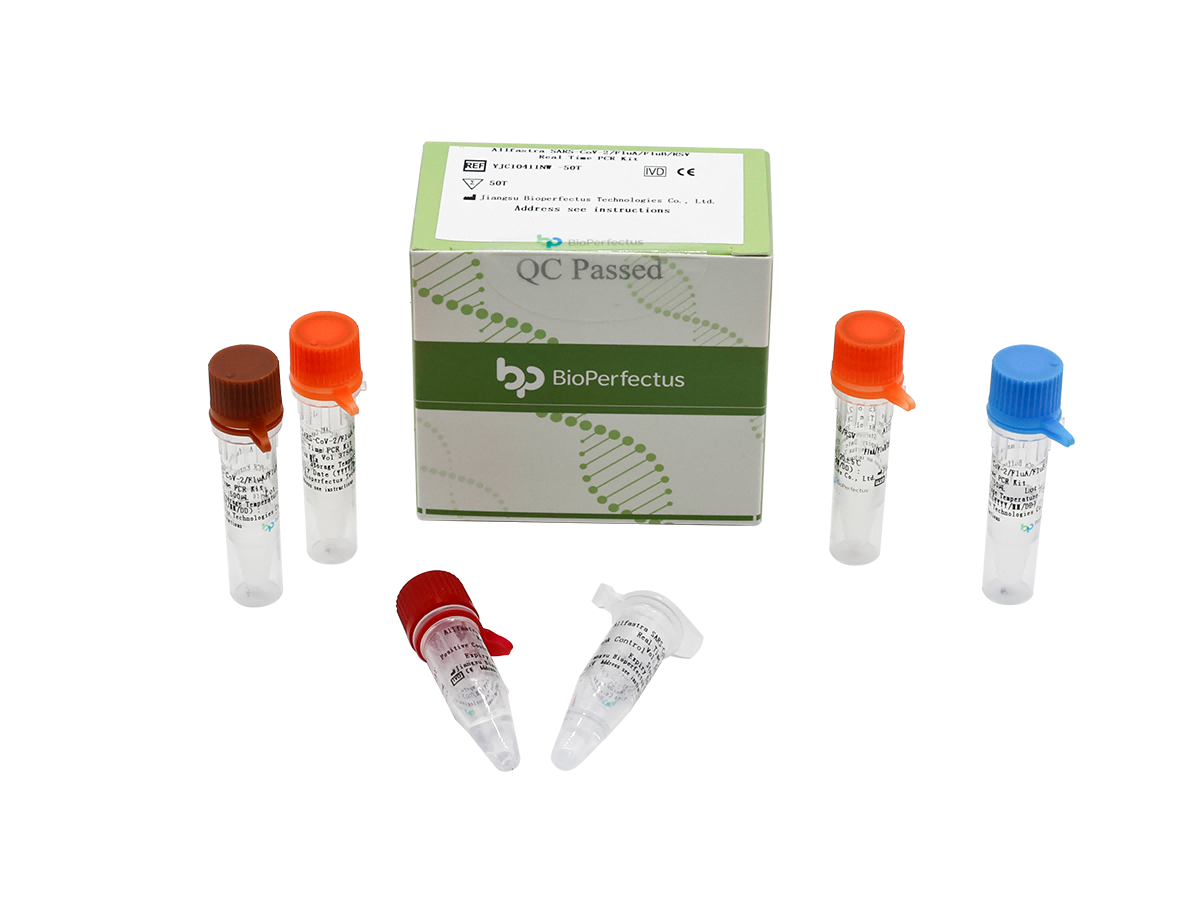
The separate Allfastra SARS-CoV-2/FluA/FluB/RSV Real-Time PCR Kit includes RSV alongside the other three viruses. Its specified specimens are human nasopharyngeal swabs, oropharyngeal swabs and sputum. A laboratory considering this product as an RSV testing kit consequently has a different target-and-specimen combination to assess from the influenza-only assay.
Compare Working Conditions on Their Own Terms
The clinical or public health assignment determines how many specimens arrive together and which target findings are required from them. Batch capacity and running time become useful after the target and specimen route are established. They describe an operating arrangement rather than a replacement for the evidence that the requested virus is included.
The BioPerfectus influenza A/B assay supports 96 tests in 109 minutes, while the Allfastra four-pathogen assay processes 48 specimens in 48 minutes on one instrument. These figures describe different stated configurations. Comparing them requires the actual workload and workflow endpoints, rather than treating the shorter interval as a complete measure of laboratory turnaround or analytical suitability.
An internal control is included in the four-pathogen assay, and its RSV target is the N gene. The control monitors the procedure while the RSV target addresses pathogen-specific detection. Those functions remain distinct during interpretation. The presence of additional viral targets also leaves the applicable control and result-acceptance rules in force for the selected method.
Materials and reaction preparation add conditions around the instrument run. Appropriate extraction, the required analytical input and supported reaction equipment form part of implementation. A proposed method can be reviewed with representative materials and its acceptance requirements, keeping that local assessment separate from a claim that every component combination has already been demonstrated.
Retain the Target Identity in the Result
A clinical report and a public health dataset may use the same laboratory observation for different purposes. Both need the pathogen identity, specimen context and method qualification to remain visible. A result from a measured influenza target cannot be relabelled as evidence about an unmeasured virus, even when the patient’s symptoms could fit either infection.
Adding the BioPerfectus four-pathogen assay to a proposed test menu introduces defined RSV coverage. The review of an RSV testing kit can then address that supported target and its specimen route, while a PCR test for flu retains its own role in influenza testing. The products answer related respiratory questions through clearly different analytical scopes.
Panel coverage determines which respiratory findings become available. Target inclusion establishes eligibility, the specimen establishes the applicable entry route, and the controlled procedure determines whether a finding can be interpreted. The test menu names the organism; the target list shows whether the selected assay can actually answer the request.